
The Cornerstone to Our Success
In an elevator system, the guide rail and guide shoe work together to keep the car and counterweight moving along the correct path. Although they serve a common purpose, their structures, installation positions, and functions are different.
The guide rail provides a fixed vertical path, while the guide shoe moves along it to control lateral movement. Understanding their differences helps elevator professionals select suitable components, identify operating problems, and plan maintenance.
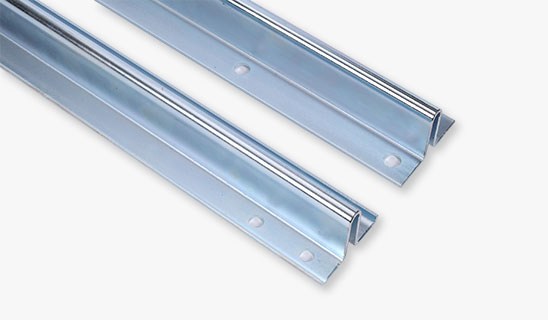
An elevator guide rail is a fixed metal component installed inside the hoistway. It guides the elevator car and counterweight during vertical travel. T-shaped steel guide rails are commonly used in elevator systems.
Main Functions of a Guide Rail:
1. Guiding movement: Provides a defined path for the elevator car and counterweight.
2. Controlling lateral movement: Helps limit unwanted sideways displacement and sway.
3. Supporting loads: Handles lateral forces during operation and provides the required reaction surface for safety gear during braking.
When selecting a guide rail, consider its cross-sectional dimensions, material properties, straightness, joint quality, and installation accuracy. The elevator's rated load and operating speed must also be taken into account.
An elevator guide shoe is installed on the car frame or counterweight frame. It contacts the guide rail and helps maintain the correct position of the moving assembly.
Common Types of Guide Shoes:
A sliding guide shoe uses a wear pad that slides against the rail surface. Its structure is relatively simple, and maintenance is well established. Regular inspection should focus on pad wear, clearance, and lubrication requirements.
A roller guide shoe uses wheels to travel along the rail, reducing sliding friction. Its performance depends on roller materials, bearing condition, spring mechanisms, and installation adjustments. It is commonly used in elevators where smooth operation is important.
Neither type is universally better. The appropriate choice depends on the elevator design and operating conditions.
| Comparison | Guide Rail | Guide Shoe |
|---|---|---|
| Installation position | Inside the hoistway | On the car or counterweight frame |
| Operating state | Fixed | Moves with the car or counterweight |
| Main function | Provides the guiding path | Maintains proper guidance |
| Common types | T-shaped steel rail | Sliding and roller types |
| Maintenance focus | Alignment, joints, and fixing | Wear pads, rollers, clearance, and fasteners |
During elevator operation, the guide shoe moves along the fixed guide rail. Their interaction helps control lateral movement and maintain the correct travel path.
Poor rail alignment, uneven joints, or worn guide shoe components may cause vibration, unusual noise, and increased wear. Therefore, proper dimensional compatibility and installation accuracy are essential.
Abnormal elevator operation may involve several components. Inspection should consider the rail, guide shoe, and their installation conditions.
| Operating issue | Possible causes | Inspection focus |
|---|---|---|
| Excessive vibration | Rail misalignment or incorrect shoe clearance | Rail alignment and shoe fit |
| Unusual noise | Worn pads, rollers, or bearings | Contact surfaces and bearings |
| Uneven movement | Misaligned rail joints or surface damage | Rail joints and running surfaces |
| Uneven shoe wear | Installation deviation or uneven loading | Shoe mounting and rail alignment |
Inspection and adjustment should be performed by qualified elevator technicians according to manufacturer instructions. Adding lubricant or changing clearance without identifying the underlying problem may not resolve the fault.
When purchasing or replacing elevator guide components, check the following specifications:
1. Guide rail specifications: Confirm the model, cross-sectional dimensions, running surface, and material requirements.
2. Guide shoe type: Select sliding or roller designs according to the elevator system.
3. Dimensional compatibility: Verify the matching dimensions, clearance, and mounting arrangement.
4. Operating conditions: Consider rated load, travel speed, and service frequency.
5. Manufacturing quality: Check rail surface quality and dimensional accuracy, as well as the quality of guide shoe pads, rollers, and bearings.
Guide rails and guide shoes should not be replaced based on appearance or similar dimensions alone. Compatibility with the original elevator design and manufacturer specifications must be confirmed.
The guide rail provides a stable travel path, while the guide shoe maintains proper guidance of moving components. Correct selection, accurate installation, and regular maintenance help reduce abnormal wear and operating problems.