
The Cornerstone to Our Success
The straightness of an elevator guide rail affects the guiding condition of the car and counterweight and is closely related to smooth operation, vibration, and noise control. It is important to distinguish between the guide rail's straightness and the overall alignment after installation. The former is mainly affected by material and manufacturing processes, while the latter can also be influenced by the hoistway, guide rail brackets, rail joints, and installation adjustments.
ISO 8100-33:2022 specifies requirements for the grades and quality, dimensional characteristics, dimensional and geometrical tolerances, and surface finish of standardized T-type guide rails and their fishplates.
The quality and condition of the steel used for guide rails can affect subsequent forming, machining, and straightening. If the material contains uneven internal stresses, deformation may occur during later processing or straightening.
Therefore, stable material properties provide an important foundation for achieving consistent guide rail geometry. ISO 8100-33:2022 also specifies material requirements for standardized guide rails.
Manufacturing processes have a direct influence on guide rail geometry. ISO 8100-33:2022 recognizes cold-drawn and machined guide rails as different manufacturing types, with high-quality machined guide rails also covered by the standard.
The accuracy of forming and machining equipment, process control, and straightening parameters can all affect the final straightness. Straightening must correct existing deformation without introducing significant new deviations.
Elevator guide rails are relatively long steel components and can be affected by improper support, stacking, handling, or external impact during transportation and storage.
These factors do not determine the original manufacturing tolerance, but they can introduce additional deformation before installation. Proper support and handling therefore help preserve the guide rail's original geometry.
The straightness and alignment of an installed guide rail system also depend on actual hoistway conditions. Deviations in the hoistway, bracket positioning, or fixing conditions can cause the installed rail to shift from its intended position.
For this reason, installation should consider actual site conditions rather than relying solely on the dimensional accuracy of individual guide rails.
Multiple guide rails are connected with fishplates to form a continuous guiding system, making the joint area an important part of overall alignment control.
If the rail ends, fishplates, or installation adjustments have excessive deviation, adjacent guide rail sections may become misaligned. ISO 8100-33:2022 includes dimensional and geometrical requirements for guide rails and their fishplates.
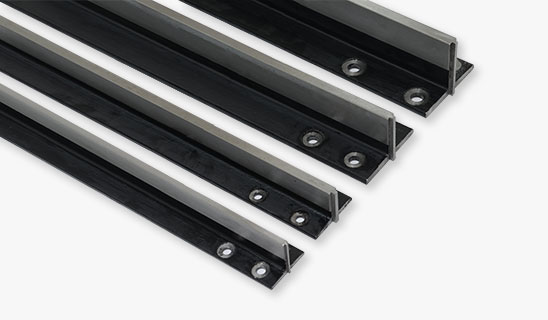
Straightness control should cover the entire process rather than relying only on final inspection. During manufacturing, attention should be given to material condition, forming, machining, and straightening. During transportation and storage, unnecessary external forces should be avoided. During installation, the actual hoistway conditions should be considered when positioning the brackets and guide rails, with particular attention to rail joints.
In simple terms, the straightness of an elevator guide rail is mainly determined by its material and manufacturing processes, while the overall alignment after installation is also affected by the hoistway, brackets, joints, and on-site adjustment. Evaluating both aspects provides a more complete basis for controlling the performance of the elevator guiding system.